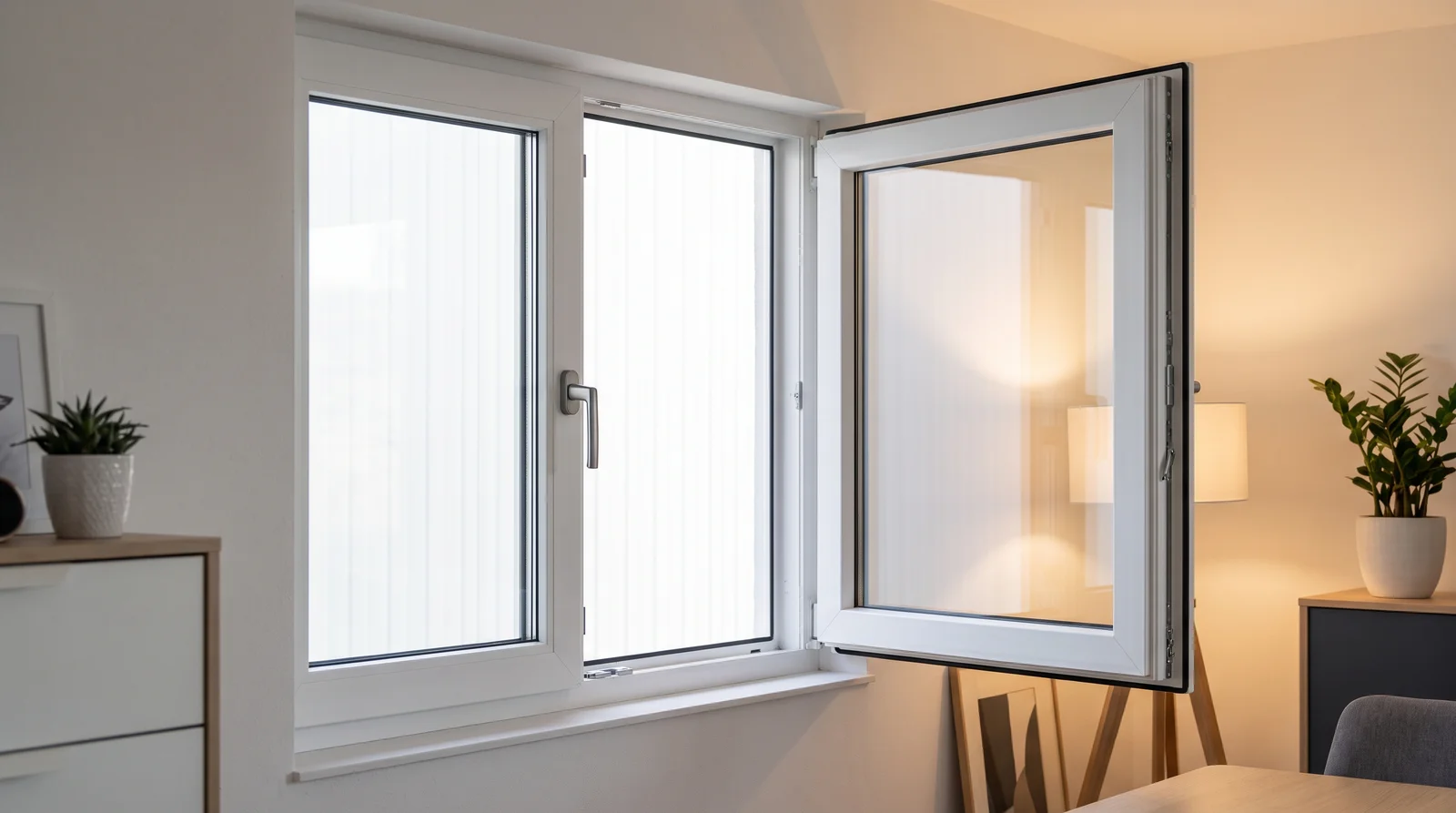
How to Maintain Windows and Doors? Answers to the Most Common Questions
Redakcja BUDVAR, 21 August 2026, 17 min read
Biannual inspection, lubrication of hardware, maintenance of seals, and adjustment of sashes. We explain what you can do yourself, what should be entrusted to a service professional, roughly what it costs, and whether an automatic window cleaner truly solves the issue of clean windows.
Contents
- How to care for windows and doors daily, and what not to do?
- How often should windows and doors be inspected?
- How to maintain windows and doors step by step?
- Does an automatic window cleaner make sense for large glazing?
- How much does window and door service cost?
- Do aluminium windows require different maintenance than PVC?
- How to clean external doors and what to remember about the lock?
- What mistakes most often damage windows and doors?
- When is replacement needed instead of maintenance?
- Frequently asked questions
How to maintain windows and doors so they function as well after ten years as they did on the day of installation? The answer is less obvious than the instructions that come with the windows and doors suggest. Cleaning the frames is just one-third of the job. Most failures result from neglecting things that aren't visible at all.
- User inspection twice a year (spring and autumn), with an additional authorized inspection every 2 years during the warranty period — in accordance with warranty conditions.
- Lubricate hardware and hinges at least once a year, applying lubricant along the entire length of the mechanism.
- Maintain seals with a silicone-based product, free of vegetable oils and mineral greases.
- Clean profiles with a gentle cleaner and a soft cloth, avoiding harsh chemicals and scrubbing.
- Pricing depends on the scope: adjustment of one window sash, entrance doors, or a comprehensive inspection are quoted individually (service prices usually exclude VAT). Contact us for a free, no-obligation quote.
- An automatic window cleaner helps maintain clean glazing but does not replace the maintenance of hardware and seals.
IN BRIEF
- Two detailed inspections per year are a reasonable minimum for all windows and doors in the home.
- Lubricate the hardware and hinges at least once a year, treat the seals with a silicone-based product, and clean the profiles with a gentle agent, avoiding aggressive chemicals.
- Adjusting a single sash through a service call typically costs somewhere in the tens of pounds, entrance doors somewhat more, and a comprehensive inspection of a whole house usually falls in the low hundreds of pounds, depending on the number of windows and doors and how much work is needed.
- An automatic window cleaner helps keep the panes clean but does not replace the maintenance of hardware and seals, and it doesn't substitute for a proper inspection by the homeowner or a technician.
Most users treat windows and doors like furniture. Wash, wipe, done. Meanwhile, a tilt-and-turn window is a mechanism with several moving parts that performs hundreds of opening, ventilating, and closing cycles under the weight of the glass each year.
Neglect is costly. Not immediately. After three or four years, the sash begins to rub against the frame, the handle becomes stiff, and in stronger winds, you can hear a whistle near the hinge. Then a simple adjustment costing a modest sum turns into a replacement of worn hardware components.
How to care for windows and doors daily, and what not to do?
The basics are simple. PVC profiles and doors with PVC panels or aluminium doors are washed with a gentle agent, water with a mild detergent, and a soft cloth. The surface is resistant to weather conditions but not to mechanical scrubbing. This procedure is recommended at least twice a year.
The frequency depends on the location. A house on a busy street or in an area with high air pollution requires more frequent refreshing because a mixture of dust, soot, and greasy traffic pollutants settles on the frames, gradually working into the surface texture over time. In rural areas, twice a year is sufficient. In city centres, four times.
What not to use? Anything that scratches or aggressively dissolves. Abrasive creams or powders, wire wool, sponges with a rough layer, solvents, acetone, white spirit, strongly alkaline cleaning agents. Improper products and accessories can leave discolorations or scratches on the profiles, damage the rubber seal, or remove the anti-corrosion coating from the hardware, which is precisely the layer that protects the mechanism from rust.
Scratching the profile is irreversible.
Another issue is handling. Proper use of windows and doors seems obvious, yet the most common hardware damage results from turning the handle with the sash open, hanging anything on the tilted sash, or closing the window with a kick when hands are occupied. The handle is turned with the sash against the frame. Always.
How often should windows and doors be inspected?
Twice a year. This is the minimum that provides real control over the technical condition of windows and doors and is a rhythm easy to fit into: once in spring after the heating season, once in autumn before it. The autumn inspection is more important for a simple reason.
Windows and doors are then heading into the most challenging period. The temperature difference on both sides of the glass increases, seals work at sub-zero temperatures, and moisture enters every gap. A window that barely closes in September will let cold air straight onto the sill in January and cause condensation on the glass.
What does a thorough inspection include? Checking the condition and stability of all hardware components, lubricating moving points, assessing seals, checking the drainage holes in the lower part of the frame, adjusting the gasket compression, and replacing worn parts if necessary. An experienced service technician does this efficiently and without unnecessary delays. Doing it yourself takes more time, but most of these tasks can be performed without specialised knowledge.
During the warranty period, an authorised inspection every couple of years, carried out by representatives of the selling company, is a useful backstop, but it is not a substitute for the twice-yearly checks described above. Those authorised visits exist mainly to confirm that everything is in order under the warranty terms; the routine, biannual maintenance is still down to the homeowner. After the warranty expires, no one monitors this at all, and that's when the mechanisms have gone through thousands of work cycles and need attention the most. A paradox that costs people the most.
How to maintain windows and doors step by step?
The order matters because lubricating dirty hardware is like rubbing sand into the mechanism. Start with cleaning, finish with adjustment.
Done systematically, it takes a moment. Neglected for years, it can stretch into an entire evening.
1. Cleaning profiles and panes
Warm water, mild detergent, soft cloth, or microfibre. With windows, it's not just about aesthetics. Cleaning windows and doors also removes aggressive deposits that accelerate surface ageing. Clean the panes from the top, finally wiping the edges and rebates where most dirt accumulates.
2. Cleaning and lubricating hardware
Open the sash, vacuum the hardware groove with a brush, wipe the metal parts with a dry cloth. Moving points, such as mushroom cams, scissor stays, hinges, and gearboxes, should be lubricated at least once a year with a product designed for window hardware. This limits mechanism wear and significantly improves the smooth operation of the sash. After lubrication, perform several full handle cycles to distribute the lubricant along the entire length of the strip.
3. Seal maintenance
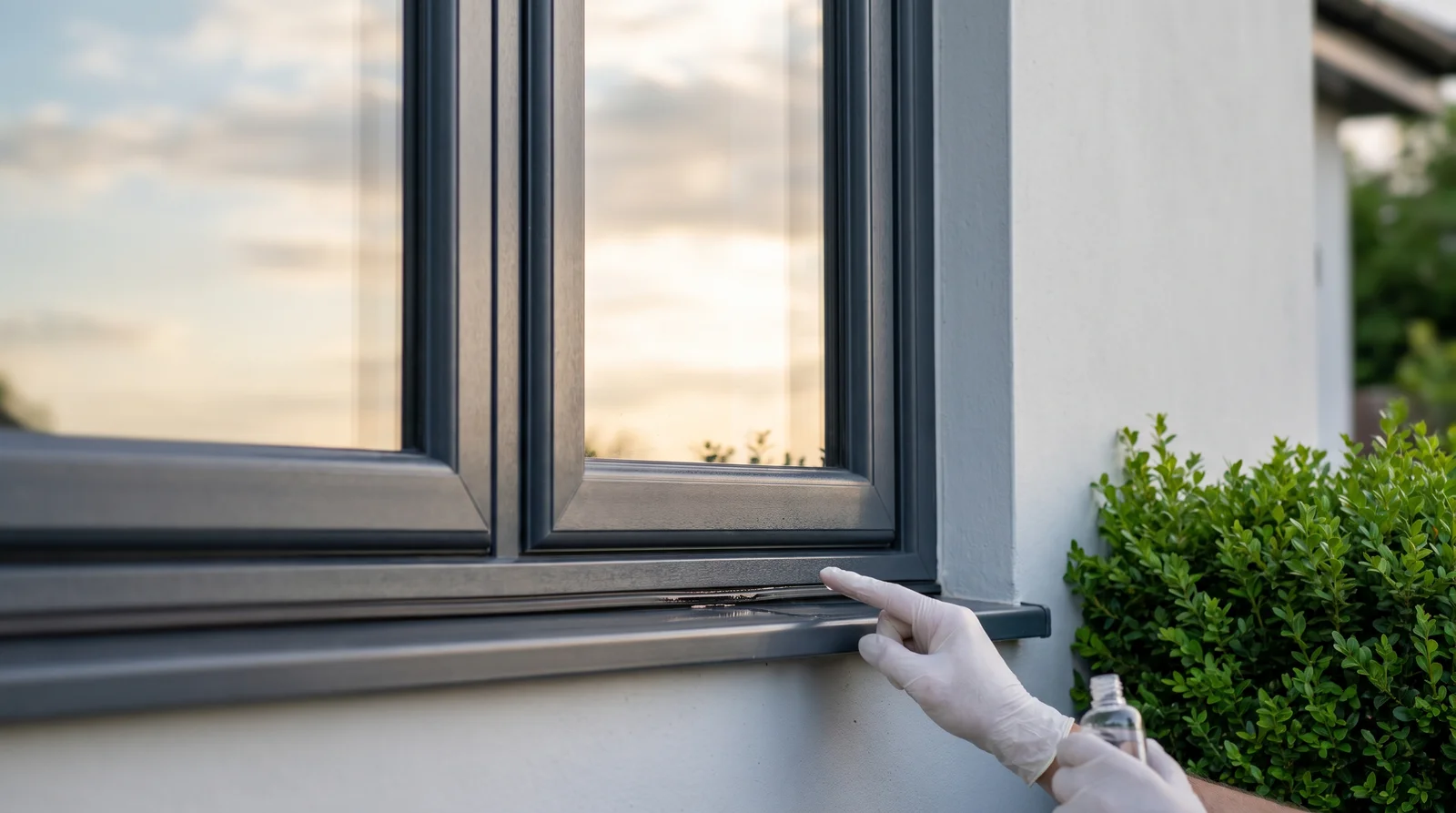
A dried seal loses elasticity and stops adhering. Wipe it with a damp cloth, dry it, and apply a silicone product that helps maintain the rubber's softness and the seal between the sash and frame for the coming months. Never use vegetable fats or mineral greases for this.
4. Drainage check
In the lower part of the frame, there are drainage holes through which condensed and rainwater escape. Blocked by leaves, dust, or remnants of installation foam, they lead to water retention in the profile and freezing of the lower edge. Check them with a wooden or plastic stick, not a sharp tool.
5. Adjustment
Gasket compression is adjusted with eccentrics on the cam, and height and lateral shift with screws in the hinges. This is the most demanding part, and for large, heavy windows or sliding systems, it's better to leave it to the service technician. A poorly adjusted sash works unevenly and wears out the hardware faster than an unadjusted sash.
More details about seals and common mistakes in their maintenance can be found in our other article on how to care for PVC windows and seals so they last for years.
Check BUDVAR's offer
PVC Windows →
Aluminium Windows →
Does an automatic window cleaner make sense for large glazing?
The question is being asked more frequently. Homes have more glass than a decade ago, and cleaning a six-metre patio glazing from a ladder is a task for the patient. An automatic window cleaner attaches to the glass with vacuum pressure generated by a pump and moves across the surface on tracks or microfibre discs, planning a route to cover the entire pane.
It works best where there is a lot of flat glass. Large fixed windows, patio glazing, shop windows, mirrors, and glass balustrades are the natural environment for such a device. A window cleaning device needs a continuous, smooth surface without obstacles. On small casement windows with dense divisions, it loses its purpose because more time is spent moving it from pane to pane than cleaning them manually.
There are two types of constructions. Square ones handle edges and corners better, while round ones usually move more smoothly and quickly over large surfaces but leave a wider margin at the frame. No model cleans the rebate or the glass-frame junction, so the last few centimetres must be finished by hand.
Manufacturers do not highlight this.
The issue of safety is more important here than the scrubbing power. The device works at height, so a safety line attached to a fixed point in the room is mandatory. An emergency battery maintaining vacuum pressure after a power outage determines whether the cleaner stays on the glass or falls onto the terrace. Edge sensors prevent it from moving beyond the pane.
What else to look at? The suction power determines working on vertical glass and whether the device stays on a wet surface. The noise level can be high because the vacuum pump operates continuously throughout the cycle, and the spraying system distributes the liquid evenly, preventing the microfibre from dry-scrubbing dust on the glass. The working time with mains power does not limit the cycle, but with battery power, it does.
And the most important caveat. An automatic cleaner solves the issue of a clean pane but does not touch anything that determines the durability of the windows and doors: it does not lubricate the hardware, refresh the seal, clear the drain, or adjust the gasket compression. It is a tool for one of the three layers of window and door maintenance, not a substitute for the whole.
How much does window and door service cost?
The range is wide and depends on the region, the company, and the type of mechanism. Adjusting a window sash through a service call typically starts at a modest call-out or hourly charge, cleaning and lubricating hardware is often priced similarly, and a more comprehensive service combining adjustment with maintenance costs somewhat more per sash. An annual inspection of tilt-and-turn windows is sometimes charged per sash as part of a wider callout.
Market rates for adjusting and lubricating one window sash commonly sit in the £tens, although lower rates per window are also encountered if a technician does several windows in one house and spreads the callout cost across the whole job. Many firms apply a minimum callout charge, so booking a technician for a single window rarely makes financial sense. It's more sensible to gather all windows and doors that need attention for one visit.
Doors cost more. Adjusting an entrance door is typically pricier than a window sash, depending on the hinge system, and adjustment combined with lubrication costs more again. The reason is simple: the door leaf is heavier, the hinges carry more load, and the multipoint lock has more elements requiring simultaneous adjustment.
A comprehensive inspection of all windows and doors in a home usually runs to £hundreds, depending on the number of windows, the type of joinery, and the scope of work. For large sliding systems, the bill can be higher. Tilt-and-slide (PSK) and lift-and-slide (HST) doors have much more complex mechanisms than a regular tilt-and-turn window, with running carriages, a guide, and a system for lifting the heavy sash.
Compare this with the cost of replacing hardware or an entire sash. A modest annual outlay for inspecting all windows in the home looks quite different when set against the bill for repairing a sliding mechanism that seized due to lack of lubrication and ran for two seasons on a dirty guide.
Do aluminium windows require different maintenance than PVC?
The principle is the same, the details differ. The powder-coated surface in an aluminium profile is hard and resistant but reacts poorly to strongly alkaline agents that dull the paint. Only mild products and a soft cloth are used for cleaning. In coastal and industrial areas, more frequent cleaning is especially important because salt and dust deposits act aggressively on the coating.
Hardware in aluminium windows tends to be more substantial because it carries greater sash weights. Aluminium allows for building wider and taller structures while maintaining frame rigidity, which is one of the main reasons for choosing this material for large glazing. This same advantage, however, means higher hinge loads and the need to monitor adjustments. A heavy sash forgives less than a light window in a small pane.
PVC wins with simplicity of use and cost. The profile does not require coating renewal, is moisture-resistant, and is practically maintenance-free apart from cleaning, which is why PVC windows are so popular among people for whom ease of maintenance is as important as technical parameters. In the offer, you will find models from T-Classic with Uw 0.84 W/m²K to T-Energy with Uw 0.57 W/m²K (up to RC2).
On the aluminium side, it's worth knowing that Ecofutural achieves Uw 0.88 W/m²K with RC3 class, and MB-79N Uw 0.80 W/m²K (up to RC2). These parameters, however, have one condition: they are maintained by tight and properly adjusted windows and doors. A misaligned sash with a dried seal loses part of the declared insulation regardless of how good a profile you bought.
How to clean external doors and what to remember about the lock?
Doors have two zones requiring a completely different approach: the sash with the frame and the locking mechanism. The sash with a PVC panel or aluminium doors is cleaned the same way as the window profile, with a gentle agent and a soft cloth, with the lower part on the outside getting dirty the fastest because it collects rain splashes from the ground. Twice a year is a sensible minimum, more often for doors facing the street.
Perimeter seals in doors work harder than in windows. The sash closes several times a day, the rubber is compressed and released, and with poor closing pressure, it begins to deform permanently in places of greatest pressure. A silicone product twice a year and checking adherence with a paper test: insert it into the gap, close the door, and pull. If it comes out without resistance, the closing pressure needs adjustment.
The lock is a separate chapter. The cylinder is lubricated with products intended for locks, never with grease or general-purpose oil, because grease binds dust, and after a few months, the key starts to jam more than before maintenance. The bolts of the multipoint lock, catches in the frame, and hinges require separate wiping and application of the appropriate product.
Doors with increased burglary resistance require more precise adjustment of hardware and lock than basic models, which is also reflected in service price lists. The more locking points and tighter tolerances, the less deviation is needed for the sash to stop closing smoothly. RC2 and RC3 resistance classes only make sense with a functional, well-adjusted mechanism.
A seized lock is always a warning signal. If the key is stiff, and turning requires pressing the sash with a shoulder, the problem is not in the cylinder but in the geometry: the bolt does not hit the catch because the sash has settled. Lubrication will not fix this; hinge adjustment is needed. If you plan to replace, review our guide on modern external doors and how to choose the right one for your home.
Check BUDVAR's offer
Aluminium External Doors →
PVC External Doors →
What mistakes most often damage windows and doors?
The list is short and repetitive regardless of whether it's a house from 2010 or 2023. First is the lack of regular lubrication of hardware and hinges, as the mechanism then works dry, metal grinds metal, and play increases each season. The effect is visible after years, and then it's too late for a cheap repair.
The second mistake is aggressive chemicals. Abrasive creams or powders, solvents, and strong degreasers can dull the profile, dry out the seal, and remove the anti-corrosion coating from the hardware in one go. People reach for them when ordinary detergent does not remove dried dirt, which is precisely when neglecting cleaning for several seasons is to blame.
The third is postponing adjustment despite visible symptoms. The sash rubs, the handle requires force, a draft is felt in the corner. The vast majority of serious failures start with minor misalignment that the user ignores until the hardware or lock is damaged, and then instead of a modest adjustment fee, you pay for parts and labour.
The fourth is skipping the autumn inspection, the moment when windows and doors enter the most demanding period of the year. The fifth, less obvious: clogged drainage holes, which no one remembers because they are hidden under the sash. Standing water in the profile chamber does more harm than frost.
The sixth mistake concerns ventilation. Keeping the window in the tilt position all day in winter cools the reveal, causes condensation on the glass edges, and promotes mould in the corner of the recess. Short, intense ventilation with the sash wide open works better and puts less strain on the hinges because the scissor stay does not work under the sash's weight for many hours.
When is replacement needed instead of maintenance?
There comes a time when maintenance no longer makes economic sense. If a window is twenty years old, with a double-glazed unit with a leaking spacer frame, rotten seals, and hardware without spare parts available, each subsequent service intervention is throwing money at a product whose parameters already fall well short of today's thermal insulation expectations.
The signals are quite clear. Fogging inside the glazing unit means loss of seal in the inter-pane chamber and cannot be repaired without replacing the glass. Profile cracks, permanent sash deformation, corrosion of hardware in several points at once, and a seal that still does not return to shape after lubrication are a set where discussing adjustment is pointless.
Building regulations also tell a story. In England and Wales, Approved Document Part L sets the efficiency standards that new and replacement windows and doors must meet, with equivalent Part L-style provisions applying in Scotland and Ireland; these are the reference points when selecting windows and doors for new builds and when replacing existing ones. It's worth checking the current version applicable to your nation before deciding, as the standards are periodically updated. An old window from the nineties will not approach today's expectations even after the best service.
The overall window U-value (Uw) is calculated based on the area and insulation of the glass, the area and insulation of the frame, and the linear bridge at the glass-profile junction, described in the EN ISO 10077-1 standard. Therefore, two windows with the same glass can have different Uw values. The spacer frame and profile width make a difference that is not visible in the catalogue if you only look at Ug.
Finally, a practical tip for those just buying. Ask for and keep the installation handover paperwork along with the maintenance instructions, as warranty terms are usually tied to carrying out periodic inspections and using appropriate care products, and a lack of documented maintenance can be grounds for a warranty claim being refused. Well-installed and systematically serviced windows work for many years without a single part replacement.
Neglected ones fall apart in five.
Frequently asked questions
Related articles