Comparing Window Prices: What a Quote Should Include
Justyna Osińska, 13 November 2026, 18 min read
Two window quotes can only be compared if they describe the same product and the same scope of work. This guide covers three quote formats and explains the difference between Uw and Ug. It also walks through two quotes for the same house and ends with a list of questions to send to contractors.

Contents
- Comparing window prices starts before you ask for a quote
- Price "per square metre": quick but misleading
- Supply-only quote: clear but incomplete
- Itemised quote for windows with installation
- What a quote for new windows must include
- Uw or Ug: the most commonly confused figures
- Installation, removal and hidden costs beyond the price of the windows
- Example: two quotes for the same house
- Checklist to send to contractors before they quote
- Frequently asked questions
The figure at the bottom of a quote tells you little when you have two in front of you: a cheaper one and a more expensive one with a longer list of items. Three things decide which is better. Do both describe the same window? Do they cover the same installation work? Do they give performance figures for the complete window, not just the glazing? The last point usually matters most, because the biggest differences sit in the technical description and only show up later, during the works or on the heating bill.
TL;DR
You can only compare quotes that describe the same dimensions, divisions, profile systems, glazing units, hardware and scope of installation. Look for the Uw of the complete window, not just the Ug of the glazing. Frames, installation, removal of old windows and accessories should each have their own line, and every price should be shown including VAT, with the rate stated.
Below we look at the three quote formats covered in this guide: a price per square metre, a supply-only quote, and a detailed itemised quote for windows with installation. After that you will find a list of what every quote must include, an example of two quotes for the same house, and a set of questions to send to contractors.
Comparing window prices starts before you ask for a quote
Problems often begin at the enquiry stage. A homeowner sends a sketch with the opening sizes to three companies, and each one chooses a configuration based on its own habits. One suggests a double-sash window with a fixed mullion, another a double-sash window with a movable mullion, and the third a single-sash window with divided glazing. The quotes then vary widely, even though nobody made a mistake: each company simply priced a different window.
The first step is a single specification, sent in exactly the same form to every contractor. It should list the size of each window, the number of sashes, the divisions, which way and how each sash opens, the colour on both sides, and the work you expect to be done. That may sound bureaucratic, but a simple spreadsheet is enough. Give each window its own number and describe each one in a row so clearly that two different sales reps could not read it two different ways.
Dimensions deserve separate attention. The quote must state clearly whether it gives the size of the structural opening, the frame size or the manufacturing size of the unit, and this is not a formality. A few centimetres around the perimeter set the width of the installation gap. If that gap is too narrow or too wide, there may be no room for the sealing tapes and sill, and the fitters end up improvising on site.
Two quotes for different windows cannot be compared, even if they are for the same opening.
Price "per square metre": quick but misleading
A price per square metre is tempting because it is so simple. In a few minutes it gives a rough budget for the whole house before any detailed window schedule exists, which is useful when a homeowner is only checking whether the project fits their finances. For that purpose, it works.
The problem is that window prices do not rise in proportion to area. What matters is how the window is built, not its size in square metres. A small bathroom window has almost as much hardware, as many corners and as many production steps as a large one, so its price per square metre comes out much higher. A large pane, on the other hand, may need a thicker glazing unit, reinforcement and heavier-duty hardware. Every mullion, extra sash or unusual shape, such as an arch, a trapezoid or a raked head, breaks the simple link between area and price.
Comparing two quotes on their price per square metre is one of the most common mistakes homeowners make. Company A may base its rate on a supply-only window with standard hardware and a white profile, while Company B quotes for a woodgrain finish, a warm spacer and sealed, layered installation. The same figure then describes two completely different products. It is like comparing car prices without checking whether one is the base model and the other fully loaded.
So who is this kind of estimate for? A homeowner or self-builder at the concept stage who wants a sense of the overall cost before commissioning detailed construction drawings or talking to the bank about a mortgage. It is no basis for a buying decision, because it lets you check neither the specification nor the scope of work.
Supply-only quote: clear but incomplete
A quote for supply-only windows, without installation, is usually the best described technically. The manufacturer lists the profile system, glazing unit, hardware and colours, because that is simply its own product documentation. As a reference point it works well: it is easy to compare two systems and see exactly what you are paying for in each line.
The weakness is obvious. A window sitting on a pallet, however good, does not insulate anything, and the costs that only appear at installation can turn the ranking of quotes upside down. Delivery, carrying the units in, removing the old windows, disposing of them, internal and external sills, sub-sill profiles, sealing tapes, anchors, installation brackets and making good the plaster at the reveals: every one of these has to be paid for somewhere. If they are not in the quote, the homeowner pays for them separately, often in a rush and with no chance to compare prices.
Responsibility is another issue. When one company supplies the windows and another fits them, both can blame each other at the first complaint: the manufacturer points to poor installation, the installer to a faulty product. Splitting the order is possible, but it needs a very precise agreement with each party, including a handover check of the windows before they are fitted.
This option suits a homeowner who has a trusted installation team, someone overseeing the works and time to coordinate several contractors. It also works on a new build where a main contractor fits the windows to drawings that already include the installation detail. In that situation, a supply-only quote makes complete sense.
Itemised quote for windows with installation
The safest option is an itemised quote for windows with installation, where every element has its own line. Windows, accessories, delivery, removal of the old units, installation, making good, sills, blinds and anything else are listed separately, each with a net price, VAT rate and total including VAT. A document like this can be read line by line.
Its biggest advantage is comparability. When two companies break down the work in the same way, you can see at once that one has included disposal and the other has not. You can also see that one has allowed for layered installation with vapour-tight and vapour-permeable tapes, while the other relies on foam alone. If one contractor is responsible for both supply and installation, their responsibility should cover all the work ordered.
There are drawbacks too. This kind of quote takes more work from the seller and a more accurate survey on site, so it usually takes longer to prepare than a figure from an online calculator. At first glance it may also look more expensive, because it includes items the competition left out, so it loses to anyone who only reads the bottom line.
It is the right choice for a homeowner replacing windows in a lived-in house, where removal, making good and cleaning up cannot be avoided. It also helps anyone applying for a grant or funding who needs clear paperwork with a cost breakdown. For more on planning the whole replacement budget, see our window advice section.
The shortest quote rarely turns out to be the cheapest once everything is added up.
What a quote for new windows must include
The list of items needed for a fair comparison is long, far longer than the one-page estimates produced by online calculators. In those, the whole technical description fits on one line and ends with the phrase "warm windows". Below are the items without which a quote is closer to a sales leaflet than a real offer to supply.
Profile and window construction
The quote should name the manufacturer, the series and the exact profile system, along with the material, colour, number of chambers, frame depth and type of reinforcement. "Warm windows" is not enough. Each window must show the number of sashes, opening directions, which parts are fixed and which open, and how the frame is divided, ideally in a drawing viewed from inside.
Glazing unit and warm spacer
With glazing, every detail counts: the number of panes and their thickness, the gas in the cavities, low-emissivity coatings, the type of spacer bar and the declared Ug. "Triple glazing" on its own does not confirm the thermal performance of the window, because the frame, the warm spacer and the size and proportions of the sashes also affect the result. If the window needs to reduce noise or resist break-ins, the quote should give the acoustic performance of the complete window and the declared burglary resistance class, together with the glazing configuration that class requires. Laminated glass alone does not guarantee good noise reduction or burglary resistance.
Hardware, handles and security features
Hardware is the easiest place to cut costs without anyone noticing. Check the quote for the type of hardware, the number of locking points, night vent (micro-ventilation), a mishandling device, a balcony door catch and opening restrictors. A locking handle does not make a window RC2. Burglary resistance classes apply to a complete product tested under set conditions, meaning the glazing, glazing beads, hardware, frame and installation method together, so the quote should state clearly what the declared class covers.
Airtightness, wind load and acoustics
How windows declare their performance, including air permeability, watertightness and resistance to wind load, is set out in the product standard EN 14351-1, published in the UK as BS EN 14351-1 and in Ireland as I.S. EN 14351-1. The quote should give these classes. For windows facing a busy road, the sound reduction index Rw matters, and for traffic noise also the C and Ctr corrections, if the manufacturer provides them. Even a high Rw will not help much if a leaky trickle vent sits in the frame or a poorly insulated roller shutter box is mounted above the window.
Documents and accessories
For standard windows covered by EN 14351-1, ask for the declaration of performance, confirmation of the product marking and the installation instructions for the system. In Great Britain, construction products carry the UKCA mark or the CE mark, which continues to be recognised; in Northern Ireland and in Ireland, CE marking applies. The marking confirms that formal requirements have been met, not that the product has the best performance on the market. Accessories should be listed as separate items: external blinds, insect screens, trickle vents, sills, frame extensions, sub-sill profiles and alarm contacts. One of the quotes you are comparing may be missing something from this list.
Uw or Ug: the most commonly confused figures
The most common technical trap lies in two similar-looking symbols. Ug describes the glazing alone, Uf the frame, and Uw the complete window, meaning the profile, glazing, spacer bar and the junctions between them, at a specific size. Ug is usually the better-looking figure. That is why a quote that only highlights the glazing value can look more attractive at first glance than a properly described competitor.
What does that look like for specific models? The T-Energy PVC window has a whole-window Uw of 0.57 W/(m²K), the T-Classic Plus 0.75 W/(m²K), and the aluminium MB-79N 0.8 W/(m²K). These values are for the complete window, not just the glazing unit. The Ug of the glazing is usually lower than the Uw of the window, because the frame, the spacer bar and the edge of the glazing lose heat more easily than the centre of the unit. When one quote gives Ug and another gives Uw, comparing the two numbers is simply a mistake.
Building regulations also set their limits for the complete window, not the glazing, and the requirements differ between jurisdictions and between replacement windows and new buildings. In England, Approved Document L sets a limiting value of 1.4 W/(m²K) for replacement windows in existing homes, or alternatively Window Energy Rating band B, and the installation must be carried out by a registered competent person or notified to building control. In new dwellings, windows are assessed as part of the whole-building energy calculation, so the values actually specified are usually well below the minimum backstop. Wales, Scotland and Northern Ireland each have their own building regulations and technical guidance, and in Ireland Technical Guidance Document L applies, again with separate provisions for works to existing dwellings and for new dwellings. A quote should therefore give Uw for the specific configuration, or at least state the reference size the value was calculated for, because a large window with many divisions can perform differently from the catalogue standard. Your local building control body can confirm what applies to your project, and you will find more background in our window advice section.
The material alone decides nothing here. PVC profiles usually make it easier to reach good thermal performance in typical residential windows, while thermally broken aluminium gives more freedom with large glazed areas, heavy glazing units and slim frames. What you compare are specific systems with specific glazing, not the labels "PVC" and "aluminium". The differences between the two materials are covered in more detail in our window advice section.
Installation, removal and hidden costs beyond the price of the windows
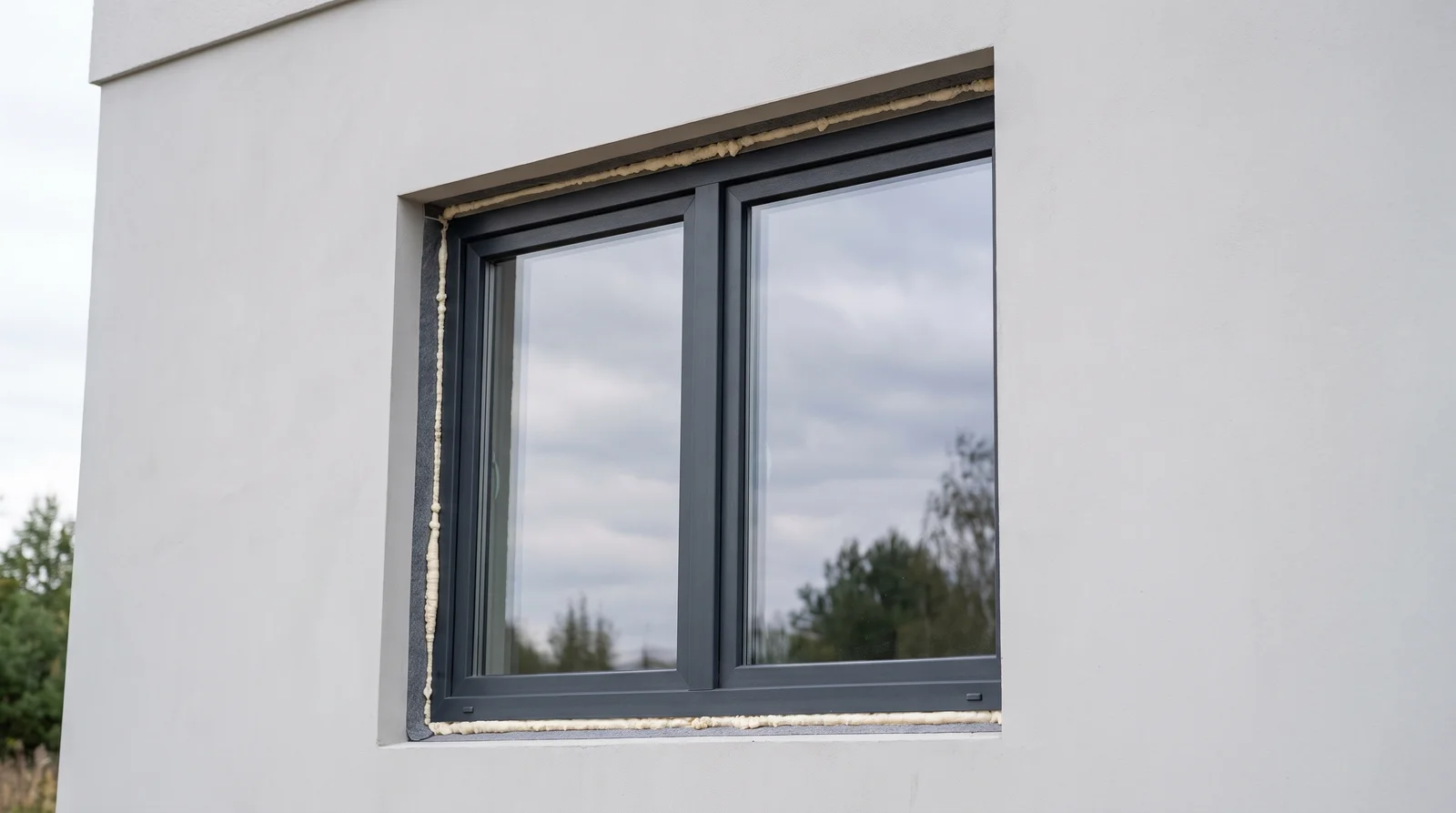
The total cost of the job covers not only the windows but also installation and related work, and how much they add depends on the scope. In quotes they are sometimes summed up in one word: "installation". That word can mean layered installation with sealing tapes, installation brackets and a system sill, or it can mean setting the frame on wedges and filling the gap with foam. Without proper sealing of the joint, the insulation in the installation gap is more likely to get damp over time, and the reveals may start to suffer from cold spots and condensation.
The quote must name the type of installation: standard, layered (sometimes called RAL installation) or installation within the insulation layer. It should also list the materials and fixings actually planned for that method, such as internal and external tapes, membranes, anchors, frame fixings, installation brackets or sub-sill profiles. Not every installation needs all of these at once, but the quote must say which will be used. Foam is not a fixing. The window must be secured with fixings spaced according to the system manufacturer's guidance; foam fills and insulates the gap but does not carry loads.
When replacing windows in a lived-in home, some tasks are easy to forget until the fitters take out the first old window. Then it turns out the reveal is crumbling and the plaster is coming away in sheets. The work includes removing the old windows, taking them away and disposing of them, repairing plaster, insulating the reveals, making good and decorating, and fitting internal and external sills. Who pays for damage caused while the old windows are being removed? Two situations need to be kept apart. Some repairs are unavoidable, such as making good a reveal that crumbles once the old frame comes out, and their cost should be agreed in advance, either included in the price or priced separately. Damage caused by the fitters through careless work is a different matter and falls on the contractor. Set out the scope of the work and who is responsible for what in writing, in the quote or the contract, before the job starts.
The way prices are shown is another trap. One company quotes net prices, another includes VAT, and a third mixes both in the same document. The VAT treatment of windows can depend on the type of building and on whether the price includes installation, so before comparing, convert every quote to a total including VAT with the rate clearly stated. Otherwise the gap between quotes may come down to tax alone.
The commercial terms are as much a part of the price as the windows themselves. The survey date, production time, delivery and installation dates, deposit terms, dimensional tolerances, and handover and complaints procedures belong in the contract, not in a phone call. The guarantee should also be broken down by component: profiles, glazing, hardware, seals, coatings, installation and any roller shutter motors, each listed separately, together with the service response time and the terms for adjustments after the first season.
The word "installation" with no description is a blank space in a quote.
Example: two quotes for the same house
Take a single-storey house with eight windows and one balcony door, where the windows are being replaced while the family stays at home. The first quote is clearly lower. But breaking both documents down line by line changes the picture completely.
This is what Quote A looks like:
- Profile described by number of chambers and frame depth, without the manufacturer's name or series,
- Glazing described as "triple glazing" with Ug given, but no Uw for the complete window and no information on the spacer bar,
- "Standard" hardware, without the number of locking points or a list of features,
- "Traditional" installation, without a list of materials,
- No removal of old windows, disposal, sills or making good; all prices exclude VAT.
Quote B includes:
- A named profile series, the colour on both sides, and a drawing of each window showing the opening direction,
- A glazing unit with a warm spacer, with the Ug of the glazing unit and the Uw of the complete window stated separately for each item,
- Hardware with night vent, mishandling device and a stated number of locking points,
- Layered installation with sealing tapes and sub-sill profile, removal of old windows, disposal, internal and external sills, and making good of the reveals,
- Prices excluding and including VAT, with the VAT rate and a guarantee broken down by component.
Once the missing items in Quote A are added (removal of the old windows, disposal, internal and external sills, sub-sill profiles, sealing tapes and VAT), its price advantage shrinks considerably and sometimes disappears altogether. The Uw remains unknown. Differences in materials and the scope of installation can be assessed before you buy, by comparing the installation method, tapes and fixings each contractor lists. The effects of poor workmanship, however, may only show up later, for example as damp in the corner of a reveal after a few winters.
This example does not prove that the more expensive quote always wins. It shows that Quote A should first go back to the contractor with a request to fill in the gaps, and only then should the two totals be compared. How a company responds to that request tells you a lot. A contractor that cannot give the Uw of its windows or name its profile system has, in effect, judged its own quote.
Checklist to send to contractors before they quote
Comparing quotes only makes sense when every company gets the same set of questions. The list below works as a form. The answer to each point should be in the quote or in an attachment. If an answer is missing, ask for the quote to be completed and for written confirmation of whether that item is included in the price.
- Number and size of each window, stating whether it is the structural opening, frame or manufacturing size,
- Number of sashes, divisions, opening direction and method, colour inside and outside,
- Manufacturer, series and profile system, number of chambers, frame depth, reinforcement,
- Glazing unit: number and thickness of panes, gas, coatings, warm spacer, Ug,
- Uw of the complete window for a specific size, or the reference size used,
- Rw, and for traffic noise also C and Ctr; air permeability, watertightness and wind load classes,
- Hardware, locking points, night vent, handles, any RC class and what it covers,
- Accessories: internal and external sills, frame extensions, sub-sill profiles, trickle vents, blinds, insect screens, alarm contacts,
- Type of installation, list of materials, how the frame is supported and where the fixings go,
- Removal of old windows, disposal, making good of reveals, cleaning and hardware adjustment after installation,
- Prices excluding VAT, VAT rate and prices including VAT, shown separately for windows, accessories and services,
- Survey, production and installation dates, guarantee and service terms, declaration of performance and installation instructions.
It is best to copy the answers into a single spreadsheet, with the checklist items as rows and each contractor as a column. Empty cells show the gaps immediately. Only when no row is missing data does the bottom-line total start to mean what it should.
A price per square metre is for rough budgeting at the concept stage. When installation is done by a separate, trusted team, compare supply-only quotes and add that team's price; when the house needs old windows removed, new ones fitted and the reveals made good, compare itemised quotes for windows with installation. If you would like a quote you can check line by line, request a free quotation from BUDVAR. Asking questions before you sign always costs less than putting things right after the first winter.
Frequently asked questions
Related articles